Saturday, April 15, 2006

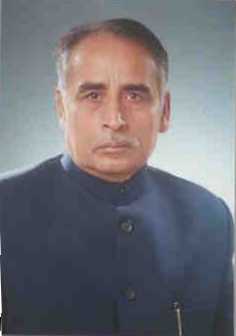
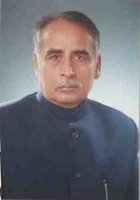
DR. CHANDRESHWAR PRASAD THAKUR


Father’s Name : Shri Radhamohan Thakur
Mother’s Name : Smt. Sharda Thakur
Date of Birth : 3 September 1931
Place of Birth : Dubaha, Distt. Muzaffarpur (Bihar)
Date of Marriage :12 June 1957
Spouse’s Name : Dr. (Smt.) Uma Thakur
No. of Sons 2
No. of Daughters 2

Educational Qualifications :
M.B.B.S., M.D., M.R.C.P., F.R.C.P. Educated at Patna Medical College, Patna University, BiharRoyal College of Physicians, London and Royal College of Physicians, Edinburgh and Royal College of Tropical Medicine and Hygiene, London
Permanent Address:
Fraser Road, G.P.O. Distt. PatnaBihar - 800 001

Positions Held
1984
Elected to 8th Lok Sabha
1998
Re-elected to 12th Lok Sabha (2nd term)
1998-99
Member, Committee on Science and Technology, Environment and Forests; and its Sub-Committee on Ganga Action Plan
Member, Consultative Committee, Ministry of External Affairs
1999
Re-elected to 13th Lok Sabha (3rd term)
22 Nov. 1999– 26 May 2000
Union Cabinet Minister, Water Resources
27 May 2000- 30 June 2002
Union Cabinet Minister, Health and Family Welfare
29 Jan. 2003- onwards
Union Cabinet Minister, Small Scale Industries; Development of North-Eastern Region

Books Published
(i) Dynamics of Development (Editor and Contributor);
(ii) Glimpses of Indian Technology (Co-author);
(iii) World Trade Organization (author);
(iv) Technical Report Series 791 upto 1990 (Geneva) Control of Leishmaniasis (joint author);
(v) Recent Trends in Leishmania Research (contributor);
(vi) Text Book of Medicine—API Text Book of Medicine (Joint author); and
(vii) India Under Atal Bihari Vajpayee, B.J.P. Era
Literary Artistic & Scientific Accomplishments

Published more than 100 research papers in medical journals and more than 200 articles in press;
Member,
(i) Scientific Working Group (Leishmaniasis), W.H.O. (Geneva);
(ii) Steering Committee (W.H.O. Geneva); and
(iii) Expert Committee (Leishmaniasis), 1988-2000;
Awarded,
(i) Padmashree;
(ii) BC Roy National Award (Indian Medical Council);
(iii) BKAIKET ORATION AWARD (Indian Council of Medical Research); and
(iv) P.N. Raju Oration Award (ICMR)

Other Information
Stood first and received gold medal in M.B.B.S. Honours;
Assistant Professor, Associate Professor and currently Emeritus Professor of Medicine, Patna Medical College; Chairman, Balaji Utthan Sansthan, Patna, 1994 onwards;
Member,
(i) Cardiological Society of India;
(ii) Indian Medical Association;
(iii) Indian Science Congress Association;
(iv) Association of Physicians of India;
(v) New York Academy of Science;
(vi) British Medical Association; organised and chaired many scientific meetings and symposia;
Revolutionised the concept of treatment of Kala-azar and recognised as an international authority in this field; and still supervising research on Kala-azar in Bihar; Member, Board of Governors, National Institute of Pharmaceutical Education and Research, 1998

Monday, April 03, 2006

Pandit Jamuna Karzee :

Pandit Jamuna Karjee was born in a small village name Deopar near Pusa in Darbhanga District of Bihar in 1898. His father Anu Karjee was a marginal farmer who died when Jamuna Karjee was just 6 months old. He grew up under the loving care and guardianship of his mother.
For attending his primary and middle school classes, he had to walk daily to a nearby village Digrah about 6 km. from his home. He was a brilliant student and won a scholarship for his education in North Brooke Jila School at Darbhanga.
From his school days itself, he was drawn towards India’s freedom struggle and the Kisan Movement and Peasant movement under Swami Sehganandji Saraswati’s leadership. For higher studies he went to the Presidency College, Calcutta, and also obtained a degree in Law.
In Calcutta he came in contact with several freedom fighters and Congress leaders like Dr. B.C. Roy, Dr. Shri Krishan Sinha, Rahul Sankritayan etc. Spurning the offers of several government jobs, he became a Hindi journalist of repute.
He joined the editorial wing of Hindi weekly Bharat Mirtra published in Calcutta. He also took part in Gandhiji’s non cooperation movement from 1920-21 and was jailed in 1929-30 for taking part in civil disobedience movement and Namak Satyagrah.
He won the first election for Bihar and Orissa Assembly in 1937 as a Congress candidate. He was one of the strongest pillars of the peasant movement in Bihar under the leadership of Swami Sahajanand Saraswati.
He along with Rahul Sankritayan and other Hindi literaries started publishing a Hindi weekly Humkar from Bihar, in 1940. Humkar later became the mouthpiece of the peasant movement and the agrarian movement in Bihar. He was elected to the post of President Bihar Journalist association in 1947-48.
He died of cancer in October 1953 at an early age of 55. After his untimely demise the peasant movement lost momentum in Bihar and became rudderless.
As remembered by Mahesh Kumar Karjee Son of Jamuna Karjee Retired Dy. G.M., Public Enterprise, presently a free lance writer. (There is also a reference of Jamuna Karjee in Bipan Chandra’s Book. India’s struggle for Independence . Chapter 27, ‘Peasant Movement in the 1930s and 40’s’.)

Tuesday, March 28, 2006

Saraswati ke Sadhak : KarmYogi & RajRishi Narayan Babu


You visit any district of BIHAR or East UP , You will find a Bhumihar Brahmin DOCTOR from GOREAKOTHI , You visit any PSU , You will find an engineer from GOREAKOTHI . In Old SARAN , It is said that GOREAKOTHI is blessed with Maa SARASWATI .

Yes , He was a visionary leader from GOREAKOTHI ( Now SIWAN) , Sri Narayan Prasad Singh who initiated the process " Importance of EDUCATION" in his area and due to his continuous effort GOREAKOTHI is on the TOP . Born on 16th December , 1887 in a bhumihar brahmin of Gotra PARASHAR Sri Narayan Babu was a real Karmyogi & RajRishi .
He was member of First Constituent Assembly in 1937 , This Assembly was having members like Motilal Nehru & Vallabh-bhai Patel and Speaker was Viththal-Bhai Patel ( Eleder Brother of Sardar Patel ) . Once , NARAYAN Babu asked Speaker to have permission to speak on PUBLIC SAFETY BILL but in HINDI , Speaker Viththal Bhai PATEL was not permitting any HINDI SPEAKER , but NARAYAN BABU was rigid , Later on with discussion , Speaker agreed with NARAYAN BABU and NARAYAN BABU became FIRST HINDI SPEAKER in PARLIAMENT . This one story shows how much NARAYAN BABU was having love for MATRIBHASHA .
Narayan Babu was very much fluent in HINDI , ENGLISH , URDU , FARASI , BHOJPURI and later on he started a magazine YOGI in Hindi language which was continue till 1972 , even Rashtra Kavi DINKAR jee edited this magazine for many years .
He wrote a Poem for KISAN - " BAIL - BATISHI" in which he described all good qualities of an OX , This poem is still popular in SARAN and BIHAR .
He was very much advocate of Social revolution and Women Empowerment which effect can be seen even today as his NATIVE "GOREAKOTHI" is always No 1 in producing Lady Teacher , Lady Doctor , Lady Advocate . This Village also proudly announce to have even prestigious AIIMs alumni .
He started KARMYOGI HIGH SCHOOL in GOREAKOTHI(SIWAN) in 1916 and till this date this school alumni counts 500+ doctors in last 90 years which include 5 doctors every year :) and 1200 + engineers and all are alumni of this SCHOOL . Important point is that WHAT FLAG he Keep ..was spreaded among all.
People from his village says He was much affluent to this KARMYOGI HIGH SCHOOL that he made a HOSTEL and use to take everyday dinner along with School Students and Teachers . Teachers were hired from across the North India . This way he was having IMPORTANCE of Education .
He died on 14th June 1950 . The very next year his son Sri Krishna Kant Singh won election in Bihar assembly from Goreakothi and become deupty education minister in SRI BABU RAAJ . In Same Cabinet NARAYAN BABU samadhi Sri ram Charitra babu from BIHAT, Begusarai was Industy and Power minister . Narayan Babu Son in Law Sri Chandrashekhar babu was CPI leader and most honest Leader same with Narayan Babu Daughter Smt Shakuntala Sinha ( w/o Chandrashekhar Babu) was also a known figure in COMMUNIST MOVEMENT in BIhar and won many elections as MLA .
Narayan Babu eleder grand son(POTA) Sri Bumendra Narain Singh is in social service and was a winner in Feb 2005 election as MLA . While Second grand Son Dr Ramendra Narain Singh is a famous surgeon in patna with double MS degrees ( MS in Ortho and MS in General Surgery ) while third grand son Dr Gyanendra Narain Singh is leading RADIOLOGIST in PATNA , They all run prestigious TARA HOSPITAL & Research Centre .
Narayan Babu another grand son(NATI) Late PYARE BABU ( Son of Sri Chandrashekhar Babu and smt Shakuntla Sinha) was a honest Industrialist were having Industrial Units in DELHI and was a quite famous in PATNA with his brand DAFFODILs ( a Studio at Dak Bunglow) . He died in a road accident in 1997 near by MERRUT (west UP) .

===========================================
I salute visionary NARAYAN BABU . In every Sector , We find such VISIONARY Person who initiated a PROCESS and was followed by PEOPLE which make that SECTOR / COUNTRY / STATE / VILLAGE ...a GREAT place .

Friday, March 10, 2006

Bhojpuri Kokila : Padm Sri Sharda Sinha


Born in 1953 in Hulas village in Bihar, Sharda Sinha received her training in music from Raghu Jha, Sitaram Hari Dandekar and Panna Devi. She also obtained degrees from the University of Patna and Prayag Sangeet Samiti, Allahabad. Shehas excelled as an exponent of folk music in Bhojpuri, Maithili and Magahi. Herinimitable style has won her wide popularity and recognition not only in herState but also in other parts of the country and abroad. She has a large numberof recordings to her credit. At present, she heads the Department of Music,Women's College, Samastipur. Earlier she has received the Padma Shri.

Wednesday, March 08, 2006

Bettiah Raaj

Bettiah Raaj
Bettiah was the capital of the little Kingdom of Bettiah, known asBettiah Raj, one of the great estates of North Bihar. It possessed arecord room or muhafizkhana. Since 1897, the Bettiah Raj was underthe Court of Wards, a colonial institution whose function was tooversee the administration of the estates which had no male heir tosucceed. The Bettiah Raj, still has its own officials who oversee dayto day administration of its landholdings and other assets, that arenot confined to Bettiah, but are in several parts of the country.Bettiah Raj's houses the official records of administrative and legalaffairs of the Raj for the past two hundred and fifty years or so,which are stored in two large halls having an storage space of 40,000and 72,000 cubic feet respectively, with a shelf space that is abouthalf a kilometer in length. It is in fact a rich repository of sourcematerials for the study of the agrarian and political history notonly of the Bettiah Raj, but beyond that also. The records are placedin bastas, which are individual bundles of records wrapped in cloth.The records includes rent registers and receipts, cash- books,village notes and settlement records, village maps, legal proceedingsand historical letters covering more than 200 years of history.Unfortunately, the order in which the records were classified is nowlost and most of them can only be found by sheer guess work or evenby accident!

TIKARI RAAJ (GAYA)

Tikari zamindari (estate), which was the biggest estateof Gayadistrict and one of the biggest of South Bihar. On account of itsbigness, it used to bementioned as Tikari Raj (kingdom). It was aboutone-fourth of size of the then Gaya district andwas paying an annualrent of 0.9 million rupees to the then British government. The estatehad anelaborate system of the assessment and collection of rent incash and kind(grains). The headquarters of the estate was in Gaya,where an Englishman used to be the Chief Manager, whowas assisted bytwo Indian managers. The whole estate was divided into 18 circles andJehanabadwas one of the circles. Below the circle used to be theKutchery, at the lavel of Mahal. EachMahal consisted of 15-20 Mauzas(villages). Kutchery housed land-rent record office and thetreasury.Money for minor repairs of ahar-pynes was provided from the Kutchery.
===================================
If Any Person having more INFORMATION on TEKARI RAAJ , KINDLY mail me on

Tuesday, March 07, 2006

BETTIAH RAAJ


  • BETTIAH (Raj)

    AREA: 4,724 km2

    ACCESSION: 1954
    STATE: Bihar
    RELIGION: Hindu / Bhumihar Brahmin


    PRESENT RULER:


    PREDECESSORS AND SHORT HISTORY: The first ruler recieved the title of Raja from the Mughal Emperor Shah Jehan (1628/1658). Rulers were...
    Raja UGRA SEN SINGH, a Jethoria Brahmin of the Kashyap gotra and founder of the state.
    Raja GAJ SINGH (son) 1659/1694, married and had issue. He died 1694.
    Raja DALIP SINGH (qv)
    Rajkumar Prithi Singh, married and had issue.
    Raja SRIKISHEN SINGH, 1st Raja of Sheohar(Bhumihar Zamindaars) in Muzaffarpur.
    Rajkumar Abdhut Singh, ancestor of the Zamindars of Madhubani in Darbhanga.
    Raja DALIP SINGH 1694/1715
    Raja DHRUB SINGH [Dhanpat Singh] (son) 1715/1762, married and had issue. He died spm 1762.
    Rajkumari Bonga Babui, married Raghunath Singh, a Bhumihar Brahmin of the Gautam gotra, and had issue.
    Raja JUGAL KISHORE SINGH (qv)
    Rajkumari Chinga Babui
    Raja JUGAL KISHORE SINGH 1762/1783, rebelled against the British in 1765, and the state was taken under their management. Later restored to him in 1771. He died 1783.
    Raja BIR KISHORE SINGH (son) 1783/1816, married and had issue. He died 1816.
    Maharaja ANANDA KISHORE SINGH Bahadur (qv)
    Maharaja NAWAL KISHORE SINGH Bahadur (qv)
    Maharaja ANANDA KISHORE SINGH Bahadur 1816/1838, granted the title of Maharaja Bahadur for personal use only in 1830. He died sp 1838.
    Maharaja NAWAL KISHORE SINGH Bahadur 1838/1855, married and had issue. He died 1855.
    Maharaja RAJENDRA KISHORE SINGH Bahadur
    Maharajkumar Mahendra Kishore Singh
    Maharaja RAJENDRA KISHORE SINGH Bahadur 1855/1883
    Maharaja Sir HARENDRA KISHORE SINGH Bahadur (son) 1883/1893, born March 1854 (#1), Maharaja Bahadur [cr.1884], K.C.I.E. [cr.1888], married 1stly, Maharani Sheo Ratna Kuwar, died 24th March 1896, married 2ndly, 1893 Maharani Janki Kuwar, born 1870, died 27th November 1954. He died sp 26th March 1893.
    Maharani Sheo Ratna Kuwar 1893/1896, died 24th March 1896.
    Maharan Janaki Kuwar 1896/1897, born 1870, a Bhumihar Brahmin Princess of Seohar, unable to manage the estate, which was taken over by the Court of Wards till her death, whereupon it escheated to the state. She died sp 27th November 1954.

Friday, March 03, 2006

He is known as KING MAHENDRA , a TRUE KING , Dr. Mahendra Prasad


Father's Name : Late Shri Baliram Sharma
Mother's Name :Late Shrimati Muluk Rani Devi
Date of Birth :8 January 1940
Place of Birth :Village Govindpur, Distt. Jehanabad (Bihar)
-
Educational Qualifications :
Graduation with Honours in Economics Educated at Middle School and High School, Okari and Patna College, Patna University
Profession :
Environmentalist, Horticulturist, Economist, Agriculturist, Political and Social Worker

Permanent Address :
(i) Vill. Govindpur, P.O. Modanganj, P.S. Ghoshi, Distt. Jehanabad ( Bihar ) (ii) 67, Patliputra Colony, Patna (Bihar).
Present Address :
4, Safdarjung Lane, New Delhi. 110011 Tel. - 23794441, 23013545, Fax 23012299,
Positions Held :

1980-84 Member, Seventh Lok Sabha
1980-94 Member, Consultative Committee for the Ministry of Chemicals and Fertilizers
1983-84 Member and Convener, Committee on Finance Jan.
1985 Elected to Rajya Sabha July 1986 Re-elected to Rajya Sabha
1986-87 Member, Committee on Rules, Rajya Sabha
1991-92 Member, Committee on Fertilizers and Chemicals
Feb. 1992 and Oct. 1993 Elected Vice-Chairman, Asian Forum of Parliamentarians on Population and Development in Japan and Malaysia (re-elected unanimously for three years) Aug. 1993 Nominated to Rajya Sabha
1993-94 Member, Committee on Finance
April 2000 Re-elected to Rajya Sabha
May 2000 onwards Member, Informal Consultative Committee for Eastern Railway
May 2000 - Feb. 2004 Permanent Special Invitee, Consultative Committee for the Ministry of Finance Member, Sub-Committee-II of Committee on External Affairs Member, Consultative Committee for the Ministry of Chemicals and Fertilizers
May 2000 - Feb. 2004 Member, Committee on External Affairs and Aug. 2004 onwards Nov. 2000 onwards Member, Governing Body of the Indian Council of Medical Research Oct. 2004 onwards Member, Consultative Committee for the Ministry of Chemicals and Fertilizers and Ministry of Steel
-
Social and Cultural Activities, Literary, Artistic and Scientific Accomplishments and other Special Interests :
-
Sports, Clubs, Favourite Pastimes and Recreation :
Was accorded the title of 'Atlantis Submariner' on 31 August 2002 by the Atlantis Submarine, Bridgetown, Barbados, West Indies for diving into the Caribbean sea to the depth of 173 feet; Member, (i) India International Centre, New Delhi and (ii) India Habitat Centre, New Delhi; Life Member (Playing Rights), (i) D.D.A. Qutab Golf Course, New Delhi and (ii) Patna Golf Club, Patna; reading and gardening (won first prizes for maintaining the best house garden in Delhi continuously for sixteen years from 1982 to 1997
Countries Visited :

Afghanistan, Albania, Algeria, Angola, Antigua & Barbuda (thrice), Andorra, Argentina, Armenia, Australia (seven times), Austria (six times), Azerbaijan, Bahamas, Bahrain, Bangladesh, Barbados (four times), Belarus, Belgium (twice), Belize, Bhutan, Bolivia, Bosnia & Herzegovina, Botswana, Brazil (twice), Bulgaria (twice), Cambodia, Canada (thrice), Chile, China (five times), Colombia, Costa Rica, Cote D'Ivoire, Croatia, Cuba, Cyprus, Czech Republic (twice - once during the erstwhile Czechoslovakia), Democratic Peoples' Republic of Korea (North Korea), Denmark, Democratic Republic of Congo-Kinshasa (twice), Dominica, Dominican Republic, East Timor, Ecuador, Egypt (twice), El Salvador (thrice), Estonia, Ethiopia (thrice), Fiji, Finland (twice), France (nine times), Georgia, Germany (eleven times - including East Germany once), Ghana, Greece (twice), Grenada, Guatemala, Guyana, Haiti, Hondurus, Hong Kong (ten times - both when it was under British control and now when it is a part of China), Hungary, Iceland, Indonesia (five times), Iran, Iraq, Ireland (twice), Israel, Italy (four times), Jamaica(twice), Japan (four times), Jordan, Kazakhstan (twice), Kenya (thrice), Kiribati, Kosovo, Kuwait, Kyrgyzstan, Latvia (twice - once when it was part of the USSR), Laos, Lebanon, Lesotho, Libya, Liechtenstein, Lithuania, Luxembourg (twice), Macau (Chinese territory under Portuguese control), Macedonia, Madagascar, Maldives, Malaysia (thrice), Mali, Malta, Marshall Islands, Mauritania, Mauritius, Mexico (four times), Moldova (twice), Mongolia, Monaco, Montserrat, Morocco (thrice), Mozambique (twice), Myanmar (Burma), Namibia, Nauru, Negara Brunei Darussalam, Nepal (five times), the Netherlands (thrice), New Zealand (three times), Nicaragua, Niger, Nigeria, Norway, Oman, Pakistan (twice), Palestine, Panama (twice), Papua New Guinea, Paraguay, Peru, Philippines, Poland (twice), Portugal, Qatar (twice), Republic of Congo-Brazzaville, Republic of Korea (South Korea - four times), Republic of Yemen, Reunion, Romania, Russian Federation (six times - twice during erstwhile USSR), Rwanda, San Marino, Saudi Arabia, Senegal (twice), Seychelles, Singapore (sixteen times), Slovakia, Slovenia, Solomon Islands (twice), South Africa (nine times), Spain (three times), Sri Lanka, Sudan, Suriname, Swaziland, Sweden, Switzerland (thrice), St. Christopher (St. Kitts) & Nevis, St. Lucia, St. Vincent & The Grenadines, Syrian Arab Republic, Taiwan, Tajikistan, Tanzania, Thailand (eight times), Trinidad & Tobago (twice), Tonga, Tunisia, Turkey, Turkmenistan (thrice), Ukraine (twice - once during the erstwhile USSR), U.A.E. (thirteen times), Uganda, U.K. (twenty-eight times), U.S.A. (seven times), Uruguay, Uzbekistan (twice), Vanuatu, Vatican City (twice), Venezuela, Vietnam (thrice), Yugoslavia, Zambia and Zimbabwe; has visited (i) 84 countries in a full year, i.e., between 9 April 2002 and 8 April 2003 and (ii) 64 countries in a calendar year, i.e., between 27 January 2002 and 28 December 2002
Other Information :

Founder, B.B.M. Inter and Degree College at Okari, Jehanabad, Bihar, a rural and most backward area of Bihar, to promote higher education among the poor, underprivileged and especially girls who cannot go to cities for higher education; Congress Party Observer during Punjab elections to Amritsar Parliamentary Constituency in September 1985 where in Batala he narrowly escaped death when his car was blasted by a powerful magnetic time bomb planted by terrorists; holds the Limca Book of Records 2004 as the most travelled person after having visited 163 countries Led, (i) Parliamentary Delegation to Hanoi (Vietnam) to attend Executive Committee Meeting of Asian Forum of Parliamentarians on Population and Development held on 24 February 1993 and the 9th Meeting of Asian Population and Development Association of Japan on 25 and 26 February 1993, (ii) Parliamentary Delegation of All Parties to Vietnam on invitation from the Chairman of Social Affairs Committee of Vietnamese Parliament and Government in September 1993, (iii) delegation to a meeting with the Chairman, Standing Committee of Cambodian Parliament (which drafted the Constitution of Cambodia), (iv) Multi-Party Parliamentary Delegation to Malaysia to attend the 4th General Assembly of Asian Forum of Parliamentarians on Population and Development in October 1993, (v) Parliamentary Delegation to Beijing to attend the 10th Meeting of Asian Population and Development Association of Japan on 2 March 1994 and also attended the Executive Committee Meeting of Asian Forum of Parliamentarians on Population and Development on 3 and 4 March 1994, (vi) Parliamentary Delegation to D.P.R. Korea (North Korea) from 5 -7 March 1994, (vii) Parliamentary Delegation to U.N.O., New York to attend Preparatory Committee Meeting of International Conference on Population and Development in April 1994, (viii) Multi-Party Parliamentary Delegation to Japan on invitation of Asian Population and Development Association of Members of Parliament of Japan from 21 - 29 May 1994 and (ix) Parliamentary Delegation to attend International Conference of Parliamentarians on Population and Development in Cairo (Egypt) and was also a Member of Indian Delegation to the International Conference on Population and Development in Cairo in September 1994, where he also attended Executive Committee Meeting of Asian Forum of Parliamentarians on Population and Development Member, (i) Indian Parliamentary Delegation to the Parliament of European Community (now European Union) at Strasbourg (France), Kuwait, Greece, Belgium and the Netherlands in June 1983, Australia and Singapore in May-June 1984 and Soviet Union, Latvia and Ukraine in May 1988, (ii) All Party Indian Delegation to China at the invitation of Chinese Parliamentary Forum on Population and Development in June, 1985 and All Party Delegation of Indian Association of Parliamentarians on Population and Development to China in September 1991, (iii) Delegation of Asian Forum of Parliamentarians on Population and Development to Indonesia in October, 1986 and in June 1987, Thailand in February 1987 and China in September 1987, (iv) Parliamentarians Action for Removal of Apartheid Delegation to West Germany, France, the Netherlands, Sweden and Norway in May 1987, (v) Conference of Global Forum on Environment and Development held in Moscow from 13-23 January 1990, (vi) Delegation to Havana (Cuba) to attend "International Meeting of Solidarity with Cuba", from 21-22 November 1994, (vii) Indian Parliamentary Delegation to the 55th regular session of the United Nations General Assembly held at New York (U.S.A.) in the year 2000, (viii) Special Indian Parliamentary Delegation to South Africa, Nigeria and Senegal from 26th January 2002 to 7th February, 2002 to put forward India's concern on cross border terrorism and the prevailing situation between India and Pakistan, (ix) All India Congress Committee (I) from 1991-2000, (x) Bihar Pradesh Congress Committee (I) from 1991-2000, (xi) Bharat Krishak Samaj (Life Member), (xii) Governing Body, Institute Body, Selection Committee and Finance Committee of All India Institute of Medical Sciences, New Delhi, and Chairman of its Grievance Committee and Estate Committee between 1980 & 1994, (xiii) National Geographic Society, Washington D.C., U.S.A., (xiv) American Management Association International, New York, U.S.A., (April 1999 to March 2000), (xv) Parliamentarians for Global Action (P.G.A.), (xvi) World Bank Parliamentary Network for International Development (PNID), (xvii) Indian Parliamentary Group (Life Member), (xviii) Indo-German Parliamentarians Forum, (xix) Indo-Hellenic Parliamentarians Group, (xx) Indo-US Parliamentary Forum, (xxi) Indo-British Parliamentary Forum and (xxii) Life Member of Parliamentary Forum on HIV-AIDS Went on Study Tour to U.S.A. and Canada in June 1976, Denmark, Switzerland, Italy, Vatican City, Egypt, U.K. and U.A.E. in June 1983, Thailand and Hong Kong in May-June 1984, Hong Kong, South Korea, Japan and Singapore in June 1985, Singapore, Philippines and South Korea in October, 1986, South Korea and Hong Kong in February-March 1987, United Kingdom in May 1987, Singapore and Malaysia in June 1987, Hong Kong and Japan in September-October 1987, Hong Kong and Singapore in October, 1987, Ethiopia and Kenya in December 1987, Ethiopia in March 1988, Austria, Spain and Portugal in April 1988, West Germany, Finland, Belgium and Luxembourg in May-June 1988, U.A.E. in June 1988, Nepal in August 1988, Hong Kong in October 1989, Czechoslovakia in January 1990, Bhutan in September-October 1990, New Zealand and Singapore in October 1990, Thailand in December 1990, Maldives in January 1991, Bangladesh and Thailand in February 1991, Mauritius and Reunion in July 1991, West Germany, Brazil, Jamaica, Panama, Canada, U.S.A and East Germany in August 1991, Burma (Myanmar) in September 1991, Thailand and Vietnam in October 1991, Hong Kong in February-March 1992, Singapore in August 1992, Thailand and Laos in February 1993, Thailand in September 1993, Sri Lanka, Brunei and Singapore in October-November 1993, Pakistan in January 1994, Hong Kong in March 1994, Ireland in April 1994, China, Mongolia and Hong Kong in May-June 1994, Nepal in June 1994, Bahrain, Qatar (twice) and Saudi Arabia in September 1994, Singapore in November 1994, Spain, Venezuela and U.S.A. in November 1994, Oman in September 1995, Republic of Yemen in December 1996, Nepal in December 1997, Turkey, Lebanon and U.A.E. in September 1998, Macao, Jordan, Hong Kong, Palestine and Israel in November 1998, Cyprus in November-December 1998, United Kingdom in December 1998, Nepal in January 1999, Liechtenstein, Hungary and Poland in May 1999, Albania and Austria (twice) in October 1999, U.A.E., Malta and Iceland in October-November 1999, Austria, Slovakia, San Marino, Kosovo, Vatican City and Italy in May-June 2000, Kazakhstan, Kyrgyzstan and Uzbekistan in July 2000, Kazakhstan, Tajikistan and Uzbekistan in August-September 2000, United Kingdom, Chile, Argentina and France in October 2000 and Andorra, Monaco, France and Spain in November 2000; United Kingdom (twice), Peru, Ecuador and Colombia in June, 2001, Belarus in September, 2001, Intermediate Study Tour to Poland on 1 October, 2001; Lithuania, Latvia and Estonia in October, 2001, Papua New Guinea, Australia, Fiji and Singapore in November 2001, Intermediate Study Tour to Australia on 9 November 2001, U.A.E. on 27 January 2002; Bulgaria, Croatia, Bosnia & Herzegovina and Slovenia in April 2002; Intermediate Study Tour to Austria on 10 April 2002 and Germany on 18 April 2002; Moldova in May 2002; Intermediate Study Tour to France on 9 May 2002; Germany on 12 May and 14 May 2002; Ukraine in June 2002 and Intermediate Study Tour to Russia on 3 June 2002 and Tunisia in June 2002; Study Tour to Turkmenistan, Armenia and U.A.E. in July 2002; Afghanistan in August 2002; Intermediate Study Tour to U.A.E. on 6 August 2002; U.K. (twice), Guyana, Trinidad & Tobago, Suriname, Barbados in August - September, 2002; Turkmenistan, Georgia in September 2002 and Intermediate Study Tour to Russia on 24 September 2002; Bahamas, Bolivia, Paraguay, Uruguay and U.K. in October 2002 and Intermediate Study Tour to Brazil on 12 October 2002 - participated in the IXth Summit of Directors' National Programme of Rabies Control in Latin America, Santa Cruz de la Sierra, Bolivia on 7 October 2002; participated in IIIrd Paraguan Congress of Anesthesiology held at Hotel Excelsior, Asuncion, Paraguay on 10 October 2002; U.K. (twice), Trinidad & Tobago, Grenada, Antigua, Dominica in the month of November 2002 and Intermediate Study Tour to Barbados on 14 November 2002; Singapore, Indonesia, East Timor in November-December, 2002 and Intermediate Study Tour to Indonesia on 1 December 2002; U.A.E. (twice), Uganda, Mozambique (twice), Swaziland in December, 2002 and Intermediate Study Tour to South Africa on 26 December 2002; Nepal in January 2003; U.A.E. (twice), Kenya, Seychelles, South Africa (twice), Namibia and Madagascar in January-February 2003 and Intermediate Study Tour to Johannesburg, South Africa on 31 January 2003; Morocco and Italy in March 2003 and Intermediate Study Tour to U.A.E. from 10-11 March 2003; U.K. (twice), Mexico, Guatemala, Honduras, El Salvador, Nicaragua and Costa Rica in March-April 2003; Ghana, Cote D'Ivoire, Morocco, Germany in September 2003; business tour to U.K. in September 2003; Study Tour to South Africa (twice), Angola, Democratic Republic of Congo-Kinshasa (twice), Republic of Congo-Brazzaville, Lesotho, Botswana and U.A.E. in September-October 2003 and Intermediate Study Tour to South Africa (twice) on 2 October 2003 and 4 October 2003; Luxembourg, St. Vincent & The Grenadines, St. Lucia, St. Christopher (St. Kitts) & Nevis, Antigua and Barbuda (twice), Montserrat in October-November 2003; Intermediate Study Tour to Barbados on 1 November 2003 and 9 November 2003; Business Tour to U.K in October 2003 and November 2003; Jamaica, Haiti, Dominican Republic, El Salvador (twice), Belize in February 2004 and Business Tour to U.K. in February 2004 and March 2004; Intermediate Study Tour to Germany on 14 February 2004, to Panama on 24 February 2004; Mexico on 27 February 2004; U.K. in July 2004, Intermediate Study Tour to Germany and Austria on 2 July 2004; Singapore (twice), Solomon Islands, Vanuatu, New Zealand, Tonga, Australia in August 2004; Intermediate Study Tour to Australia on 3 August 2004; Ethiopia in August-September 2004, Rwanda in September 2004, Intermediate Study Tour to Kenya on 5 September 2004, United Kingdom (twice), France, Mali, Mauritania and Niger in October-November 2004; Intermediate Study Tour to U.A.E on 23 October 2004, Senegal on 1 November 2004 and Morocco on 4 November 2004; Singapore (twice), Australia (twice), Nauru, Kiribati in November-December 2004; Intermediate Study Tour to Solomon Islands on 29 November 2004 and Marshall Islands on 3 December 2004; U.K. (twice) in May-June 2005 and France in June 2005 and Ireland and U.K. (twice) in October 2005 Visited, (i) Tanzania to attend the 75th Anniversary of African National Congress in December 1987, (ii) Zambia and Zimbabwe to attend the meeting of the Association of West European Parliamentarians for Action against Apartheid in March 1988, (iii) Oxford (England) to attend the Global Conference of Spiritual and Parliamentary Leaders on Human Survival in April 1988, (iv) Bangkok (Thailand) to attend the 3rd General Assembly of Asian Forum of Parliamentarians on Population and Development in October 1990, (v) Seoul (South Korea) to attend the meeting of the Asian Population and Development Association in February 1991, (vi) Tokyo (Japan) to attend the meeting of Asian Forum of Parliamentarians on Population and Development in February 1992, (vii) Bali (Indonesia) to attend the Fourth Asian Pacific Population Conference in August 1992, (viii) Kuala Lumpur (Malaysia) to attend the International Conference of Asian Parliamentarians on Environment and Sustainable Development in November 1994, (ix) Damascus International Trade Fair, Damascus (Syria) from 7-9 September 1998, (x) Tehran International Trade Fair, Tehran (Iran) from 3-4 October 1998, (xi) Baghdad International Trade Fair, Baghdad (Iraq) from 4-5 November 1998, (xii) Taipei International Medical & Pharmaceutical Fair, Taiwan from 14-15 November 1998, (xiii) C.Ph.I. (Chemical & Pharmaceuticals Ingredients) Trade Fair, Amsterdam (the Netherlands) from 2-4 December 1998, (xiv) T.T.T.F. International Trade Fair, Ashgabat, Turkmenistan, 12-14 March 1999, (xv) Clock & Watch International Trade Fair, Basel (Switzerland) on 2 May 1999, (xvi) T.I.B.C.O. International Trade Fair, Bucharest (Romania), 25-27 May 1999, (xvii) International Trade Fair GALENIA (on pharmaceuticals) held at Plovdiv (Bulgaria), 19-20 October 1999, (xviii) C.Ph.I. Trade Fair, Frankfurt (Germany), 2-4 November 1999, (xix) International Exhibition of Equipment & Instrument for Medicine & Pharmaceutical Industry "MEDIPHARM" held at Belgrade (Yugoslavia), 31 May - 3 June 2000 and also visited Kosovo, (xx) Leon (Mexico) from 3-4 October, 2000 in connection with International Trade Show for Medical Products, Equipment Services "HOSPIMEDICA MEXICO", (xxi) C.Ph.I. (Chemical & Pharmaceuticals Ingredients) Trade Fair, Milan (Itlay) from 7-9 November 2000, (xxii) Washington (U.S.A.) as a Member of FICCI Delegation to attend the Indo-US Business Meet and US-India Business Council's Annual General Meeting from 17-20 June 2001, (xxiii) World Food, International Fair for Foodstuff Industry, Moscow (Russia) from 26-28 September 2001, (xxiv) C.Ph.I. (Chemical & Pharmaceuticals Ingredients) Trade Fair, London (U.K.) from 8-9 October 2001, (xxv) International Exhibition CIA 2001 (ChemAsia 2001, Instrument Asia 2001 and AnaLabAsia 2001), Singapore from 1-2 November 2001, (xxvi) International Fair "MEDICINE 2002" on medical and pharmaceuticals equipment, skopje (Macedonia) from 10-12 April 2002, (xxvii) Berne (Switzerland) to attend the Third Annual Conference of Parliamentary Network on World bank from 9-11 May 2002, (xxviii) Prague (Czech Republic) on a Business Delegation from 26-29 May, 2002, (xxix) International Dental Exhibition & Conference - STOMATOLOGY-2002 at Len Expo, St. Petersburg (Russia) from 29 May 2002 to 1 June 2002 and (xxx) Algiers (Algeria) from 15 - 17 June 2002 and Tripoli (Libya) from 18-19 June 2002 as a Member of FICCI Delegation, (xxxi) Algiers International Trade Fair (held from 12-24 June 2002) on 17 June 2002 at Algiers (Algeria), (xxxii) Miami, Florida (U.S.A.) in connection with Florida International Medical Expo held from 21-22 August 2002 at Miami Beach Convention Centre, Florida, U.S.A., (xxxiii) Baku (Azerbaijan) in connection with Baku International Healthcare Exhibition-BIHE-2002 on 21 September 2002, (xxxiv) C.Ph.I. (Chemical and Pharmaceuticals Ingredients) Trade Fair, Ville-Pinte, Paris, France from 1-3 October 2002, (xxxv) Ottawa (Canada) to attend the 24th Annual Parliamentary Forum of Parliamentarians for Global Action (P.G.A.) from 4-6 November 2002, (xxxvi) Khartoum International Fair at Khartoum, Sudan from 20-21 January 2003, (xxxvii) Athens (Greece) to attend the 4th Annual Conference of Parliamentary Network on World Bank from 9-10 March 2003; (xxxviii) Mexico City (Mexico) to attend Expo AFM, International Pharmaceuticals Exihibition held at World Trade Centre, Mexico City from 25-28 March 2003; (xxxix) C.Ph.I. (Chemicals & Pharmaceuticals Ingredients) Trade Fair, Messe Frankfurt, Germany from 27-28 October 2003, (xl) Paris (France) to attend the 5th Annual Conference of Parliamentary Network on World Bank from 14 - 16 February 2004; (xli) Chisinau, Moldova from 2 - 5 July 2004 wherein State Medical and Pharmaceutical University "Nicolae Testemitanu" conferred the title of "Doctor Honoris Causa" (Honorary Degree of Doctorate) on 3 July 2004; (xlii) Wellington (New Zealand) to attend the Parliamentarians for Global Action (PGA) III Session of the "Consultative Assembly of Parliamentarians for the International Criminal Court (ICC) and the Rule of Law" held between 6 & 7 December 2004 hosted by the Parliament of New Zealand, (xliii) Islamabad (Pakistan) to attend the PGA Sub-Regional South Asian Parliamentary Seminar on HIV/AIDS organized by Parliamentarians for Global Action in collaboration with National Assembly and Senate of Pakistan on January 14-15, 2005 and (xliv) Helsinki (Finland) to attend 6th Annual Conference of Parliamentary Network on World Bank from 21st to 23rd October 2005

Sunday, February 26, 2006

Rags to Riches : Mr. SAMPRADA SINGH


How a young Patna University graduate with a simple family background became the head of the major pharmaceutical company in India is Samprada Singh’s unusual story. Mr Singh, founder and chairman of Alkem Laboratories, a Rs 750 crore pharma company, could probably say he owes his success to his initial misfortunes which he translated into success with entrepreneurial zeal and a positive mental attitude. Born and brought up in Bihar, he wanted to be a doctor. Since this dream could not be realised he was compelled to explore other pastures. In 1946, he entered Gaya College, Patna University to specialise in commerce. Once he obtained his graduate degree, Mr Singh thought he would, like his parents, work in agriculture. However, successive droughts in the Bihar constrained him to change his plans once again. In 1953 Mr Singh opened his first business, a small chemist retail store in Patna. Seven years after opening his medical store, Mr Singh felt it wasn’t enough. He started a business of pharmaceutical distribution in 1960 under the banner of ‘Magadh Pharma’. During these years, he started cultivating doctors and senior executives from major pharma companies. “My relationships pharma big bosses were excellent,” he explains. Once again, after a few years, Mr Singh was already thinking of new ways to expand. Realising how limited were opportunities for the distribution business in Patna, he moved to Mumbai, where he decided to set up his own pharmaceutical company under the name ‘Alkem Laboratories’. The company’s beginnings were not easy, admits Mr Singh. “There were many conflicts of power then in the industry and many did not wish to see me succeed,” he said. Besides, “the capital initially invested in the company was small, and the first years were financially difficult.” The company started its activities by focusing on anti-bacterials, NSAIDs, etc which at that time were prime therapeutic segments.
Then came the turning point which catapulted Alkem Laboratories into the Big League. In 1989, Alkem Labs successfully manufactured and marketed Taxim, a generic version of the antibiotic cefotaxime. MNC Hoechst Marion Roussel (now Sanofi Aventis) were the innovators of the product and the company’s brand dominated the market at that time. “Aventis probably felt that a relatively small Indian company like ours may not pose them any threat but they were in for a big surprise. We surged way ahead of them,” said Mr Singh. The competitive prices offered by Alkem Labs could not possibly be matched by the French company, which soon had to completely halt production. “Taxim really changed the whole profile of the company. It gave the company more visibility and a new credibility,” he told ET. Today, Alkem Labs ranks number seven in the domestic market and sells 75 million vials of Taxim per year, which probably represents more in terms of volume than any given molecule’s sales in the world. Taxim also accounts for around 15% of the company’s revenues. Over the years marketing and finance became Alkem’s strengths. Alkem Labs has a very strong track record of building brands. In fact, Alkem is today a zero debt company and 12 of the company’s brands feature among the top 300 pharma brands in India. Mr Singh mainly attributes the growth of his company to his ability to entertain the best relations possible with his employees, associates and distributors. “Gaining people’s trust and commitment is one of the most important things to succeed. You have to make sure that all people you work with, whether they work within or with the company, are happy and you have to make them grow too, as the company expands,” explains Mr Singh. At 79 years, Mr Singh still has great plans for the company’s future. Not only is he about to open a new division dedicated to nutraceuticals and food processing, but he also intends to make Alkem Labs one of the top five Indian pharma companies within 2 years, primarily by increasing international presence in addition to domestic consolidation. The target is set high at Rs 2000 crore for 2010. But Mr Singh is confident. “That’s not a problem, it will be easy,” he concludes with a smile. Mr Singh’s life story epitomises the old English adage “From tiny acorns grow mighty oaks.”
more links on Samprada Singh , quite famous as SAMPRADA BABU who inspired a lot of youth to take PHARMA BUSINESS as thier CAREER .

Saturday, February 25, 2006

Homage to Dr R.K.Sinha


Homage to Dr R.K.Sinha
Dr Suresh Nandan Sinha*
Dr Radha Krishna Sinha-a doyen of English literature in India is no more. After living a full life, he left for heavenly abode at the ripe old age of 88 on the 29th of August at the Patna residence of his eldest daughter, Dr Manju Rani Sinha, Retd Principal, Magadh Mahila college, Patna University.
Dr Sinha joined Patna University as a lecturer in English in the year 1937 and after eight years, he left for U.K to undertake research work under David Cecil-a renowned critic of English literature. He obtained DPhil degree from Oxford University on D. H. Lawrence. He was acclaimed in his time as one of the four great scholars on Lawrence in English world. His write-up entitled ‘Forms of fiction’ was widely appreciated all over the world in the field of English fiction.
On his return from U.K, he was elevated to the post of University Head of the department of English in Patna University in 1952 at the age 35 and had the distinction of being the youngest University Head of a department in Patna University.He held this post till he retired in 1977. Dr Sinha was a voracious reader of English novels. Whenever this scribe had had an occasion to go to his residence, he was found engrossed in reading books but he loved to remain surrounded by scholars of his liking. Being an aristocrat by birth and coming from an affluent family, he seldom did any manual work; even a pen he infrequently touched to write anything and wrote letters in others’ handwriting putting his signature only. Once while moving in a book fair in Delhi, I happened to see a book authored by him. I wondered and asked Mrs Rama Jha, ( Wife of eminent writer Akhileshwar Jha ) who was mannig the stall of Chanakya Publications as to how Dr R.K.Sinha could write the book when he was known as one who seldom touched pen. She narrated to me how She interviewed Dr Sinha and tape recorded the answers to her questions on varied aspects of English novel and produced the same in the book form which was then before my eyes.
Dr Sinha would ever be remembered not only for his scholarly career in English literature but also for his genial disposition, his sterling qualities of head and heart and above all for his loving temperament which endeared him to all.
*The writer is Retd Professor of MIT Muzaffarpur

Monday, February 20, 2006

Socialist Leader : KAPILDEO BABU : Barahiya

KAPILDEO SINGH : A TRIBUTE
Dr Shaibal Gupta

Kapildeo Singh died the day when two luminaries of India were born, Mahatma Gandhi and Lal Bahadur Shastri. He was possibly the last thinking leader from the once great socialist movement of Bihar. He was really a byproduct of Sahajanand’s Kisan movement, who had galvanized several Bhumihar tenants to turn leftward. Kapildeo Singh, however, had transcended from Kisan movement to Socialist movement. If economic deprivation alone had concerned him then, his natural ideological home would have been communism; but his deep concern for social issues as well led him to the path of socialist movement. He imbibed some of the best cultures of the left movement, in particular the quality of combining grassroot struggle with voracious reading. He would reel out names of several important books and authors with the drop of a hat. His reading list was wide ranging and enviable. With almost child like pride, he would display his library, a rare possession of a public figure, more so in the Hindi Heartland.
His general disposition pattern did have the brashness of ‘Baraiha’, which emerged as a counterfoil to ‘Arrah’, but he used his brashness for the toiling masses and for tormenting the landlords of the ‘Taal’. This ‘people centric’ brashness was not limited to his political movements only, it was also in full display during his short stint as a Minister as well. His brashness and academic efflorescence were in full use as a Minister of Food in the United Front Government in 1967. He, along with Indradeep Sinha (Minister of Revenue) and Chandra Sekhar Singh (Minister of Irrigation and Power), the two giants of the communist movement, not only tackled successfully the prevailing draught, but also laid the foundation for the ‘Green Revolution’ in Bihar. If Bihar is self-sufficient in food grain now, its foundations were laid by this trio. Indeed, that was possibly the only period of ‘good governance’ in Bihar which was the result of academic foundation of the men at the helm of affairs, their experience of grass root movement and public probity. After the JP movement, while the social base and political power of socialist ideology expanded, the formal party itself got eclipsed. Kapildeo Singh, unlike many of his socialist contemporaries, did not allow himself to be ideologically drifted. At the time of his death, he must have been an ideological loner. He kept up his intellectual probity and ideological brashness dying in the company of a veteran socialist, Janeshwar Mishra, fortunately not in the company of a ‘market centric’ socialist like Amar Singh.

Tuesday, February 14, 2006

In LALU - RABRI RAAJ

This was Published in The Economic Times and Reporter seems to be a Bhumihar Brahmin who written this in context of then Lalu Rabri raj & Bhumihar . But in present there is a sentence in BIHAR , KURMI ko TAAJ and BHUMIHAR ko RAAJ
----------------------------------------------------
NEW DELHI: For the Bhumihars, a landowning upper caste localised mainly in Bihar, these are very difficult times. A community which played a glorious role in the freedom movement and the zamindari-abolition agitation is today fighting hard to maintain its identity. Having produced the first chief minister of the state in the post-independence era, the community, like the other upper castes, is now struggling to maintain its relevance in the political space. A community which delivered luminaries such as Dr Shrikrishna Sinha, Sir Ganesh Dutt, Chandrashekhar Singh, Ram Dayalu Singh, Shyam Nandan Mishra, Langat Singh in the field of politics, and Ram Dhari Singh `Dinkar,’ Rahul Sankrityayana, Rambriksha Benipuri and Gopal Singh `Nepali’ in the domain of Hindi literature, is in the throes of a major turmoil, with history-sheeters and criminals threatening to become role-models. The first attempt to rally the Bhumihars under a banner can be traced back to the 1880s, when Hathua Maharaj, one of the several members who had been assigned land revenue-collection rights by the British, and Rai Bahadur Ram Gopal Singh Chaudhary formed the `Akhil Bharatiya Bhumihar Brahmin Mahasabha.’ When Mahatama Gandhi launched the movement against the British indigo planters’ exploitation of the farmers of Motihari in north Bihar in 1917, intellectuals and educated persons, cutting across caste-lines, joined it in droves. Among the prominent Bhumihars who were lured into the movement were Dr Shrikrishna Sinha, Ram Dayalu Singh, Ramnandan Mishra, Shilbhadra Yaji, Karyanand Sharma as well as kisan movement leaders such as Swami Shahjanand Saraswati.
Two main streams gradually developed among the Bhumihars. While Sir Ganesh Dutt went on to represent the interests of the landed class, Swami Shahjanand took up cudgels on behalf of the farmers and instigated them to rise against the exploitation of the zamindars and the British administration. Inspired by Mahatama Gandhi’s call to all Indians to join the freedom movement, quite a few Bhumihars laid the foundations for educational institutions. Son a poor farmer hailing from north Bihar, Langat Singh set up the famous L S College in Muzaffarpur. Several other colleges and schools were set up in places like Muzaffarpur, Sitamarhi, Begusarai, Munger and Biharsharif. While a substantial number of Bhumihars joined the Congress heeding Gandhiji’s call, the socialist and communist movements also drew them in large numbers. Dr Shrikrishna Sinha went on become the first chief minister of undivided Bihar. Under his leadership, Bihar went on to become the first state after the attainment of independence to abolish the zamindari system. The socialist stream in the state too had its fair share of Bhumihars. Prominent among them were Ramnandan Mishra, Ganga Sharan Sinha, Basawan Singh and Kapildeo Singh.
A close associate of Loknayak Jai Prakash Narain, Ramnandan Mishra shot into fame when he, along with JP, scaled the walls of the Hazaribagh central jail during the Quit India movement to lead the underground movement against the British. The Communist movement in the state too drew a large number of Bhumihars. Leaders such as Karyanand Sharma, Chandrashekhar Singh, Kishori Prasanna Singh and Indradeep Sinha made a mark among the peasants and landless labourers. In the 1967 general election, the Communists joined hands with the socialists and the Bharatiya Jan Sangh to defeat the Congress party for the first time. They subsequently formed the first non-Congress United Front government in the state under the chief ministership of late Mahamaya Prasad Sinha. Chandrshekhar Singh, Indradeep Sinha and Kapildeo Singh went on to become cabinet ministers in the government. As per the 1930 census, Bhumihars comprised some 4 % of the total population of undivided Bihar. Districts such as Begusarai, Lakhisarai, Muzaffarpur, Jahanabad, Gaya, Vaishali, Patna, Khagaria, Sitamarhi, Gopalganj and Samastipur have a Bhumihar population ranging from 1.5 lakh to 4 lakh. The Bhumihars as a political force lost their clout in the post-Mandal era, ceding the space to the Yadavs and the other OBCs. In the Rabri Devi ministry, there is just one Bhumihar.

Sunday, February 12, 2006

Swami Sahjanand Saraswati


The Swami
The foremost of the leaders of the peasantry in Bihar was Swami Sahajanand Saraswati. Sahajanand was born in Ghazipur district in eastern U.P. in the late nineteenth century (1889?) [Sahajanand, 1952] to a family of Jujautia Brahmins. He was the last of six sons and had no sisters. His mother died when he was a child and Naurang Rai (as he was known then) was raised by an aunt. His father, Beni Rai, although a Brahmin, was primarily a cultivator, and was so divorced from priestly functions that he did not even know the gayatri mantras. The family held a small zamindari, income from which had sufficed in Sahajanand's grandfathers' time, but as the family grew and the land was partitioned, prosperity dwindled and (tenant) cultivation became the main occupation. However, the family was not so extremely poor that its condition would prevent Naurang from going to school, where he did very well both in the primary grades and in the German Mission high school where he studied English. Even at an early age, however, Naurang showed sings of brilliance and scepticism of conventional populist religious practices. He questioned the institution of people taking guru- mantra from fake religious personages and wanted to study religious texts deeply in order to be able to find real spiritual solace by renouncing the world. To prevent him from doing this, his family had him married to a child bride but, before the marriage could stablise, in 1905 or early 1906, his wife died. The last fetter in his way to sanyas (renunciation of the world) having been removed, in 1907 Naurang Rai was initiated into holy orders and took on the name of Swami Sahajanand Saraswati. This adoption of sanyas prevented him from appearing for the matriculation examination but he spent the rest of his life, especially the first seven years after sanyas, in studying religion, politics and social affairs. In all these he became increasingly radicalised so that towards the end of his life, the world was presented with the incongruous sight of a saffron-clad swami who denounced organised religion [Sahajanand, 1948:96-123].

However, before Sahajanand came to this stage, he had to traverse a long road. His first involvement in public activity started from the very narrow casteist Bhumihar platform. Only gradually did Sahajanand become involved in nationalist Congress politics, and then in peasant movements, progressively in Patna, Bihar and, finally, all over India.

Even in order to get to the peasant question, however, Sahajanand went through political schooling in Congress under Gandhi. In fact, the Swami and the Mahatma had a curious filial relationship. Sahajanand started off in Congress as a devoted Gandhian, admiring Gandhi's fusion of tradition, religion and politics and, by 1920, threw himself into the nationalist movement as directed by Gandhi. However, he first became disgusted with the petty, comfort-seeking hypocrisy of the self-proclaimed `Gandhians' especially in jail and, within 15 years, he was disillusioned with Gandhi's own ambiguity and devious pro-propertied attitudes. The final break came in 1934 after Bihar had been violently shaken by the great earthquake of that year. During the relief operations in which Sahajanand was deeply involved, he came across many cases where, in spite of the destruction perpetrated by the natural calamity, he found the suffering of the people to be less on account of the earthquake than as the result of the cruelty of the landlords in rent collection. When Sahajanand found no way of tackling this situation, he went to meet Gandhi, who was then camping at Patna, to ask for advice. Gandhi sanguinely told him, `The zamindars will remove the difficulties of the peasants. Their managers are Congressmen. So they will definitely help the poor' [Sahajanand, 1952:426]. In spite of this, the oppression of the peasantry by the `zamindari machinery including Congressmen managers' continued. These platitudes of Gandhi disgusted Sahajanand and he broke off his 14 year association with the Mahatma. After that, he consistently saw the Mahatma as a wily politician who, in order to defend the propertied classes, took recourse in pseudo-spiritualism, professions of non-violence and religious hocus-pocus.

After his break with Gandhi, Sahajanand kept out of party politics (though he continued to be a member of the Congress) and turned his energies into mobilising the peasants [Hauser, 1961:109-133]. By the end of the decade, he emerged as the foremost kisan leader in India. In this task of organising the peasants, at different times his political impetuosity took him close to different individuals, parties and groups. He first joined hands with the Congress Socialists for the formation of the All-India Kisan Sabha; then with Subhas Chandra Bose organised the Anti-Compromise Conference against the British and the Congress [Sahajanand, 1940]; then worked with the CPI during the Second World War [Das, 1981]; and finally broke from them, too, to form an `independent' Kisan Sabha [Rai, 1946]. In spite of these political forays, however, Sahajanand remained essentially a non-party man and his loyalty was only to the peasants for whom he was the most articulate spokesman and forthright leader. As a peasant leader, `by standards of speech and action, he was unsurpassed' [Hauser, 1961:85]. He achieved that status by a remarkable ability to speak to and for the peasants of Bihar; he could communicate with them and articulate their feelings in terms whose meaning neither peasant nor politicians could mistake. `He was relentlessly determined to improve the peasants' condition and pursued that objective with such force and energy that he was almost universally loved by the peasants, and almost equally both respect and feared by the landlords, Congressmen and officials. The Swami was a militant agitator; he sought to expose the condition of agrarian society and to organise the peasants massively to achieve change. He did this through countless meetings and rallies which he organised and which he addressed in his own inimitable forthright manner. He was a powerful speaker speaking the language of the peasants. Sahajanand was a Dandi Sanyasi and always carried a long bamboo staff (danda). In the course of the movement, this staff became the symbol of peasant resistance. They cry of "Danda Mera Zindabad" (Long live my staff), was thus taken to mean "Long live the danda (lathi) of the Kisans" and it became the watchword of the Bihar peasant movement. The inevitable response by the masses of peasants was "Swamiji ki Jai" (Victory to Swamiji) [Hauser, op cit]. "Kaise Logey Malguzari, Latth Hamara Zindabad" (How will you collect rent as long as our sticks are powerful?) became the battle cry of the peasants.

This was the manner in which a common communication was achieved. And it was vastly enhanced by the fact that Sahajanand was a Swami, which gave him a tremendous charisma. In 1937, he was reported to have said that as religious robes had long exploited the peasants, now he would exploit those robes on behalf of the peasants' [Hauser, ibid]. When landlords raised the question as to how a sanyasi (mendicant) was taking part in temporal problems of the poor, Sahajanand quoted the scriptures at them:

Prayen deva munayah swavimukti kama
Maunam charanti vijane na pararthnsihthah
Naitan vihaya kripnan vimumuksha eko
Nanyattwadasya sharanam bhramato nupashye

(Mendicants are selfish, living away from society, they try for their own salvation without caring for others. I cannot do that, I do not want my own salvation apart from that of the many destitutes. I will stay with them, live with them and die with them)[Sahajanand, 1952:171].
Such was Swami Sahajanand Saraswati, the charismatic sanyasi rebel, who laid the foundations of kisan organisation in Bihar, built it up into a massive movement, spread it to other parts of India and radicalised it to such an extent that what had started off as a move to bring about reform in the zamindari system, ended up by destroying the system itself. Sahajanand could not, however,m witness the legal death of zamindari in BIhar. While the battle for this was still being fought in the legislature and the courts, on 26 June 1950, Sahajanand passed away [Sudhakar, 1973:14].

Friday, February 10, 2006

Bihar Kesari : Dr. Sri Krishna Singh


'Bihar Kesari' Dr. Sri Krishna Sinha was born on 21st October, 1887 in his maternal grandfather's house, Khanwa.He got his early education in his village school, and later in Zila School, Monghr, where he gradually emerged as promising student leader. At Monghyr, by the Ganges, he avowed to work relentlessly and without rerspipte to free India from the English. Dr. Sri Krishna completed his education in Patna University. He started practising law in1915, but gavae it up in 1921 to take active part in Mahtma Gandhi's non co-operation movement . As the echoes of his voice spread around Bihar, people began calling him 'Bihar Kesari'.Sri Krishna Babu first went to Jail in 1922. He underwent different terms of imprisonment for a total of about eight years. In 1930, Sri Babu played an important trole in 'Namak Satyagrah' at Garhppura. During arrest he suffered severe scalding injuries to his hands and chest.Under the Act of 1935, Sri Babu formed his Cabine Patna on 20th July, 1937. He disagreed with the Governor on the issue of the realease of political prisoners and resigned. The Governor had to give in finally and Sri Krishna Baby resumed his office. But he again resigned im 1939 over the question of involving India in the Second World War without the consent of the Indian people. Impressed by this courage ofDr. Sinha, Mahatma Gandhi in 1940 awarded him the distincting of being called ' the first Satyagrahi'm of Bihar.Ast the Chief Minister, Dr. Sri Krishna Sinha served Bihar continuously from 1946 to 1961. He was always interested in self study and his ideas and speeches were noted for their wisdom. He wasa staunch opponent of casteism and always rose in defence of the oppressed, the backward and the Harijans.
He passed away on 31st January, 1961.
--------------------------------------------------------------------------------

Rashtra Kavi : Ramdhari Singh "DINKAR"

RAMDHARI SINGH DINKAR :


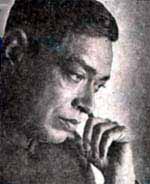
Ramdhari Singh 'Dinkar' (रामधारी सिंह दिनकर) (1908 - April 24, 1974) was one of the most famous modern Hindi poets. He emerged as a rebellious poet with his nationalist poetry in pre-Independence days.
Dinkar was born at the Simariya village in Begusarai district of Bihar in a Bhumihar family. As a student, Dinkar's favorite subjects were history, politics and philosophy. He studied Hindi, Sanskrit, Bengali, Urdu and English literature. Dinkar was greatly influenced by Iqbal, Rabindranath Tagore, Keats and Milton.
In his early days, Dinkar supported the revolutionary movement during the Indian Independence struggle. But later, he became a Gandhian. However, he used to call himself a 'Bad Gandhian' because he supported the feelings of indignation and revenge among the youth. In Kurukshetra, he accepts that the war is destructive, but says that it is necessary for the protection of freedom.
Dinkar was awarded the Jnanpith Award in 1972 for Urvashi, a work of poetry, published in 1961. The theme of Urvashi revolves round love, passion, and relationship of man and woman on a spiritual plain, distinct from their earthly relationship. The name Urvashi is derived from the name of an Apsara of the same name (Urvashi), a celestial damsel of the court of Hindu mythological god, Indra.

Major poetical works
Renuka, Hunkaar, Dwandwageet, Saamdheni, Rasavanti, Baapu, Kurukshetra, Rashmirathi, Urvashi, Dhoop aur Dhuan, Itihaas ke aansoo, Neel Kusum.

Wednesday, February 08, 2006

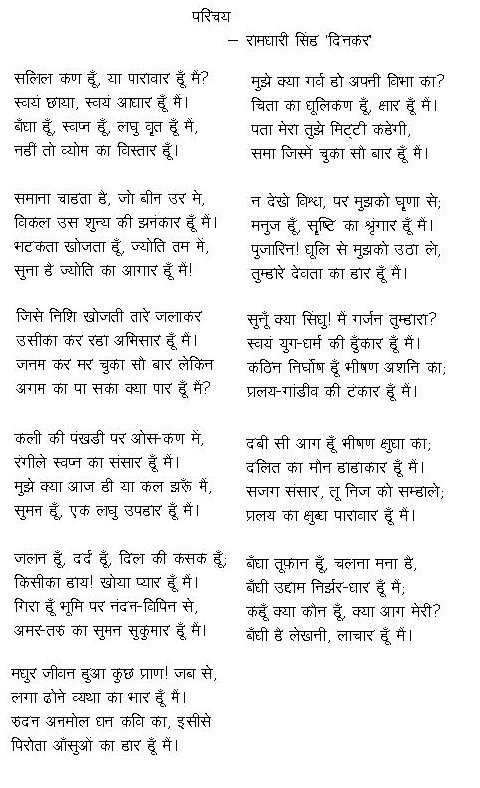
PARICHAY : Rashtra Kavi Ram Dhari Singh DINKAR


-----------------------------------------------------
Please Download This POEM and then Inlarge it by Inlarge Button or Click on link given

Tuesday, February 07, 2006

Sheel Bhadra Yajee : Freedom Fighters Part - II


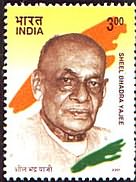
Sheel Bhadra Yajee

Sheel Bhadra Yajee (1906-1996) the fiery freedom fighter from Bihar was associated with the non-violent and the violent form of freedom struggle. Yajee's participation in the freedom movement began in 1928 when, as a student, he attended the Calcutta Session of the Indian National Congress. He joined the Congress Socialist Party four years later and became involved in the Kisan movement. Later, he came in close touch with Subhas Chandra Bose, as well as Mahatma Gandhi. In 1939 he joined Subhas Chandra Bose to found the All India Forward Bloc. He was actively associated with the INA movement. Yajee raised his voice against caste prejudices and other social evils. He was a firm believer in the active participation of the peasants, workers and the middle classes in the struggle for the transformation of society. He authored several books like' A Glimpse of the Indian Labour Movement', 'Forward Bloc and Its Stand', 'Is Socialism a Necessity to India', and 'True Face of Monopolistic American Democracy'.
==========================================================
His native was BAKHTIYARPUR , PATNA and so Bhumihars from this area are known as YAJEE bhumihars . Ghoswari- Champapur is SASURAAl of Mukhiya Jee ( Ranjan Rituraj Sinh) .
-----------------------
Sri Yajee jee also founded All-India Freedom Fighters' Organisation , when he retired from active politics . There are several books on Yajee jee contribution to Society as Freedom Fighter , as Kisan Leader and as a parliamentrian . and one of them is Sheel Bhadra Yajee, a living legend of the freedom struggle: Books: V.L Sundar Rao by V. L Sundar Rao.
-----------------------
he represented Bihar as Indian National Congress member in RAJYASABHA to counter the philosphy of LOHIA in

Yogendra Shukla & Baikunth Shukla : Freedom Fighters - Part I


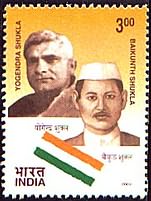
Yogendra Shukla and Baikunth Shukla

Yogendra Shukla (1896-1966) as well as his nephew Baikunth Shukla (1907-1934) hailed from village Jalalpur in Muzaffarpur (now Vaishali), district of Bihar and were torch bearers of the revolutionary spirit of freedom struggle. Young Yogendra made his greatest contribution to the cause of Indian freedom between 1930 and 1942, as one of the leaders of the revolutionary movement in Bihar and U.P. becoming "Almost a legendary figure for his many exploits". He was a close associate of Bhagat Singh and Batukeshwar Datta. He had to serve prison terms for a total of more than sixteen and a half years for his revolutionary activities. During imprisonment in different jails of India, he was subjected to extreme torture, which corroded his iron constitution.
Baikunth Shukla was also initiated into the freedom struggle at a young age taking active part in the 'Salt Satyagraha' of 1930. He was associated with revolutionary organisations like the Hindustan Seva Dal and Hindustan Socialist Republican Association. The execution of the great Indian revolutionaries, Bhagat Singh,Rajguru and Sukhdev in 1931 as a result of their trial in the 'Lahore conspiracy case' was an event that shook the entire country. Phanindra Nath Ghosh hitherto a key member of the Revolutionary Party had treacherously betrayed the cause by turning an approver, giving evidence, which led to the execution. Baikunth was commissioned to plan the execution of Ghosh as an act of ideological vendetta which he carried out successfully on 9th November 1932. He was arrested and tried for the killing. Baikunth was convicted and hanged in Gaya Central Jail on May 14th, 1934. He was only 28 years old.
===============================================
There is a GIRLS HIGH SCHOOL on the name of Yogendra Shukla in "HAKAAM" , Gopalganj , Bihar . Its native of MUKHIYA JEE ( Ranjan Rituraj Sinh) , on 29th January 2001 , Sri ram Vilas Paswan released this stamp in the capacity of Union minister under Mr Vajpae Government .

Monday, February 06, 2006

A Maharajah's Festival for Body and Soul


---------------------------------------------------------------------------------
THIS ARTICLE WAS PUBLISHED IN NEW YORK TIMES ,Just 30 days back to Maharaja death .
---------------------------------------------------------------------------------
November 26, 2000
A Maharajah's Festival for Body and Soul

By RICHARD SCHECHNER, a professor of performance studies at the Tisch School of the Arts at New York University, is working on a book about Indian theater and ritual.

RAMNAGAR, India A KING, his prince and his courtiers ride in full pomp atop richly caparisoned elephants. They, along with tens of thousands of spectator-devotees, their hands pressed together in the Hindu prayer-salute, admire and worship the gods Vishnu and Lakshmi in their incarnations as Rama and Sita. Titanic battles pit human-size gods against 50-foot-high demons.
For a whole month there is continuous theater, 31 daily episodes of love, war, exile, intrigue and adventure. The stages for this performance of great magnitude are locations dispersed, filmlike, throughout Ramnagar (literally, Ramatown), a midsize settlement across the Ganges River from the holy city of Benares in the north Indian province of Uttar Pradesh.
Ramnagar is the seat of the Maharajah of Benares, Vibhuti Narain Singh, still revered by multitudes of Indians more than 50 years after losing his crown and his kingdom when the Princely State of Benares was dissolved into the Union of India in 1949.
This is Ramlila, or Rama's play: participatory environmental theater on a grand scale. Ramlila is theater — and it is religious devotion, pilgrimage, a festive fair and political action. Audiences range from a few thousand for some episodes to 100,000 for others. Every Hindu Indian, and most Muslims, know the story of Ramlila; it is always being presented in films, on television, as graphic art and in literature, ranging from great poetry to comic books. There are thousands of local Ramlilas enacted all over Hindi-speaking India — and in the diaspora, too, from Trinidad to Queens.
But the Ramlila of Ramnagar is different. It features the Maharajah of Benares as patron, director and player. It is many days longer than other Ramlilas. It is more skillfully produced theatrically. It draws much larger and more devoted crowds. And its future may be more precarious.
During Ramlila, Ramnagar is transformed into a living theatrical model of the entire Indian subcontinent, from the Himalayan mountains in the north to Sri Lanka off the southeast coast. Nothing of Ramlila's size, totality and intensity has been seen in the West since medieval times. Compared with Ramlila, the Oberammergau Passion Play and Peter Brook's "Mahabharata" are small scale.

Like all great art, Ramlila changes its meaning over time. Nationalist sentiments, present mostly as a vague background 25 years ago, now operate openly, especially among many younger male spectators. And today's Hindu nationalists, wanting to turn India into a Hindu state, hold Ramraj up as their ideal.

Under the watchful eye of the Maharajahs of Benares, Ramlila has been performed in Ramnagar every year since the early 1800's. But how long it will continue is no longer certain. The pressures of India's ever-increasing population and the nation's vigorous economic growth threaten this unique theatrical-religious cycle.
Ramlila needs lots of time and space — scarce in today's India. People who once would support Rama in his war against Ravana now run businesses that can't be ignored for a month. At the same time, forests, ponds and open sites are being eaten up by housing and highways. Even finding younger actors and technicians to replace those already well past retirement age is proving difficult.
As an American theater director who has studied Ramlila since 1976, I am fascinated by its scale, by the attention to detail in its staging, lighting, scenic design and costuming, by the acting and singing, and by the convergence of narrative, spectacle, devotion and politics. I have seen all 31 episodes twice and, along the way, interviewed the Maharajah, the Rajkumar (crown prince) and many participants and performers in the play, as well as a number of spectators. In September, I went to Ramnagar to see portions of this year's spectacle, as I have in other years.
Ramayana means Rama's journey, and Ramlila suggests this journey literally. There are no seats. People sit on the ground, stand, watch from rooftops or perch on walls. When the action calls for it, the crowd moves from one location to another. Following in Rama's footsteps is fundamental to Ramlila. This movement is a kind of pilgrimage, a worship-in-action.
The festival itself transforms an area of many square miles. Some of the stages are enclosures in the middle of the town, others are deep in what was once forest and jungle, or on grassy hillsides and in open fields, or amid large gardens of fragrant blooming trees and temples and marble gazebos built by former maharajahs. For one scene, the stage is the Maharajah's own palace, known as the Fort, which it really once was.
Each episode is called a lila. On most days, Ramlila begins at 5 p.m. and continues until 10 at night. Some episodes last late into the evening and one, Rama's coronation, does not end until dawn.
The staging is simple and iconographic, replicating images from temples, religious paintings and popular posters. The costumes are richly woven silks in resplendent gold and red. The faces of some actors are adorned with glittering jewels. Many colorful masks and large, brightly painted papier-mâché effigies animate the performances.

But this tradition is no longer secure, though it has persevered for more than 100 years. Kaushal said he did not want his son to portray Ravana. "Life as a farmer is too hard," he said. "The Maharajah has no money anymore. I want my son to work in the city." The sentiment is heard frequently these days.

The original Ramayana poem itself is never spoken because Sanskrit is a language very few Indians understand. Instead, what people hear is the Ramcharitmanas, a 16th-century Hindi version of the epic. The entire Manas, as it is called, is chanted by 12 men sitting each night in a circle close to the Maharajah. But even though at Ramlila one can see dozens of people reading texts of the Manas, many others cannot understand its archaic Hindi. To enable everyone to follow the story, a maharajah in the mid-19th century, Ishwari Prasad Narain Singh, commissioned a group of poets and scholars to compose dialogue in vernacular Hindi for the Ramlila.
First, the Maharajah ritually worships weapons and horses — the symbols of his royal power. Next, he and his court mount magnificently adorned elephants and parade through the adoring crowd from the Fort to Lanka. The Maharajah then proceeds through the battleground and departs. "It is not proper for one king to witness the death of another," the Maharajah told me. "Therefore, I do not stay to watch this lila."
One group that always gains maximum pleasure and devotion from Ramlila are the sadhus, holy men who have renounced worldly goods, live on alms and spend their days and nights singing praises to the gods. The Maharajah provides all sadhus with daily rations of rice and lodging. But despite this generosity, there are many fewer sadhus than before. "Who wants to renounce the world these days?" a man asked me.
And where there used to be lightly traveled paths leading into the quiet countryside, now there are streets clogged with diesel fume spewing trucks and buses, horn- blasting cars and motorcycles, not to mention bicycles, cows, water buffalo and goats. The deeply rutted dirt roads have not been filled or smoothed for years.
Why is the Ramlila so enormous? The most direct answer is that since the early 19th century, the Ramlila has been the defining project of the Maharajahs of Benares. The current line was established in the mid- 18th century and, caught between a failing Mughal power and an emergent British presence, was not secure on the throne. Sponsoring a large Ramlila was the way for the Maharajahs of Benares to shore up their religious and cultural authority at a time when they were losing both military power and economic autonomy.

Vibhuti Narain Singh ascended the throne in 1939 when he was a boy of 12. Ten years later, his kingdom was dissolved. But the Maharajah continued to rule, not in political fact but by virtue of his learning, his religious devotion and his patronage of Ramlila. Wherever he goes, people greet him with ringing shouts of "Hara! Hara! Mahadev!" ("Shiva! Shiva! Great God!"), because he is believed to be a manifestation of Shiva, the Hindu god of destruction and reproduction. Now 73 and frail, unable to walk unassisted, the Maharajah is doing all he can to pass the Ramlila on unchanged.

With the participation of Nissar Allana, a stage designer, and myself, the Maharajah is planning a Ramlila museum, which will take shape first as an Internet site with thousands of images, as well as sound recordings and scholarly and historical materials. Kapila Vatsyayan, one of India's leading performance scholars, hopes to edit a facsimile edition of an early-19th-century illuminated manuscript, a four-volume version of the Manas with hundreds of original illustrations in a style influenced by Mughal painting.

I am helping to prepare a prompt book detailing all of the current staging — a how- to-do-it manual that the Maharajah hopes will assist his son, Anant Narain Singh, who is now in his 30's, when it becomes his turn to oversee the Ramlila.

The Ramnagar Ramlila has thrived for nearly two centuries as a magnificent spectacle, a religious experience and a cosmic drama. But will it make it through the next 25 years? The crown prince has never known what it is to rule a state. Is his devotion as intense as his father's? Can he command the same respect? He is a more modern man than his father. Is it an irony or a sign of the times that on several occasions when we have met, I was dressed in Indian kurta and pajamas, while he wore casual Western clothes?

Meanwhile, money is a big problem. Environments and costumes are beginning to look rundown. Performers receive a few hundred rupees as a contribution to those who do sacred work. At one time, this money amounted to something, but no longer. Atmaram, the 80-year-old supervisor of props, sets, lights, costumes and special effects, was not sanguine about the future. "I am training no one," he said. "After I am gone, who will know what to do?" Atmaram has been on the job for more than 50 years. The knowledge he carries in his head is not replaceable.
Until now, few outsiders have attended Ramlila. It doesn't make sense to go for one day, and Ramnagar does not have the infrastructure to accommodate longer visits, unless one is ready to rough it. For more foreigners to come — or even for upscale Indians from Delhi and Calcutta — Ramnagar will require extensive upgrading. The crown prince is studying the possibility of converting a portion of the Fort into a five- star hotel.
Yet everyone recognizes that Ramlila's uniqueness is a function of its nontourist Indianness, of its being theater and more than theater at the same time. Will increased attention from outsiders help preserve or further disturb Ramlila?

---------------------------------------------------------------------------------------
Although , I teach Technology and Management but HISTORY always fascinate me . i just delight whenever i see my forefathrs (Bhumihar Brahmins) were in lead to serve the society or to make society enable.

Wednesday, February 01, 2006

Kashi Naresh : History Part II

His Highness Maharaja Bahadur Dr Vibhuti Narayan Singh
Consequently, during the nineteenth century the British administered the Banaras region directly, with the ruling Bhumihar family occupying a vague position somewhere between that of large landlord and the ruler of a princely state ( For a delineation of the rights accorded to the Raja, and how they exceeded those available to ordinary large landholders) While the government officially maintained the distinction in status between Banaras and the other "native princes" ruling elsewhere in the subcontinent (these enjoyed legal status under the doctrine of "internal" or "limited sovereignty"), India Office administrators debated in the 1870s whether or not the characterization of Banaras as a "mere zamindary" was grossly misleading ("A History," 1873). Earlier studies have suggested that nineteenth-century direct rule by the British represented a collapsing of the levels of political authority from three to two; that the British came to represent both the national and the regional level of authority. ( The new interpretation of the political history of the Banaras region sketched here reflects a shift of focus from overtly political arenas to those expressed by cultural activities. This shift enables us to make different measurements about the extent of power and influence exercised by the dynasty within the political economy of the area. As a result, we argue that the Raja maintained an important politicocultural influence that kept alive the intermediate "regional" function within local society.)
But in 1910–11 the British government took the unusual action of creating a new princely state of Banarasinvesting the Maharaja with "full ruling powers" over the area encompassed within his zamindari. ( He was to receive a 15-gun salute, and could be received and visited by the Viceroy.)While retaining direct British rule in the city of Banaras, the British nevertheless recognized the Maharaja's cultural influence there by allowing him to retain his capital at Ramnagar (situated directly across the Ganges River, and the only other town of any size in the district). This decision to re-create the princely state was informed in part by early-twentieth-century British political concerns.
The move also, however, officially recognized the ongoing politicocultural influence possessed by that triad of collaborators—the Bhumihar dynasty, the Gosains, and the merchant-bankers. In turn, it also perpetuated this influence: in its unofficial and then official role as princely state, Banaras provided important patronage for Indian artists and intellectuals, as well as opportunities for talented Indian administrators. The Maharaja's council, for instance, reflected the confluence of mercantile, landowning, caste, and educational elite possessing what we refer to here as "Hindu merchant-style" culture (see below). Together the triad shaped this culture so successfully that it integrated those who resided in the city in a way that came to be virtually unparalleled in urban north India.
to be continued.......
Ranjan Rituraj Sinh , Gopalganj